Tuesday, April 19, 2011
Artists' Work, War and Museums
"Evan" by Anne Sherwood Pundyk, 2010, 24" x 24," Oil and Acrylic on Panel
Kolarov notes that in 1915 -- another time of war -- Freud wrote about a theoretical positioning of the function of the museum and museum culture with respect to war. Freud’s observations on the state of war (which he considered an exception) and its impact on the norm of peacetime suggest the psychic parameters of contemporary artists’ current work. He focuses on the crumbling of the ethical norms that structure the space of the museum at times of war. During peacetime, members of western civilization enjoy the foreign “cultures” hosted within the walls of the museum. In wartime what has allowed this pleasure reveals itself in its pure form: the reduction of the world and its history into a manageable size for consumption. This is possible because the museum’s audience is stuck in an unenlightened, self-focused state of mind.
The premise for Freud’s speculation, Kolarov suggests, is that the museum contains products of war. War opens the doors of culture to looting (a close relative to creative transgressing) and also reignites the hungry aggression that powered the construction of the museum in the first place. In a sense, museums honor the aggressive acts with forms of celebration that mimic mourning by using funeral procession-like arrangements of objects in cases and in rows. Psychologically those aggressors must put a distance between themselves and their violent acts by framing the contents of the museum as being from the past, from faraway, or to be kept and considered for the future (and forever.) The museum maintains a distance between the housed artwork and its audience – preventing the process of mourning and allowing for the denial of the violence and transgressions of war.
How do contemporary artists, creating new art, grapple with this distance required by the museum: the source of their support and credibility? Kolarov formulates two possibilities: one, that artists can choose between denying that the original works they create are connected to or refer to western civilization and its violent practices – in other words – their creations come out of nothing. But in so doing, they eventually have to admit that the work then means and is worth nothing. A second choice is to embrace the museum’s culture of war, even to enhance the attractiveness of violence by connecting it to sex. This option promotes the image of the artist as having a destructive, transgressive character – a distancing devise familiar to those versed in museum culture.
We are now in a time of war. Are there other possible responses besides completely denying our state of war or worse, participating in the insidious hidden-in-plain-sight consequences of war culture? Is it possible for all involved to acknowledge the wrongs and transgressions of our participation in war, to fully mourn the losses of war together as a “civilization,” and to rebuild our collective conscience?
Saturday, April 16, 2011
Look at my other blog: Express + Local: NYC Aesthetics
!
Tuesday, March 1, 2011
Lindsay Captured Red-Handed and Seven Other Outlaw Stories
PRESS RELEASE
Saturday, February 5, 2011
Performance in Art
Tom Thayer, Paper Puppet and Scenery from The New World Pig, 2009-2010, paper, tape collage, graphite, 12 × 17.75 inches. Image courtesy of Derek Eller Gallery
I write about Adam Marnie, Tom Thayer, and Ruby Sky Stiler at Derek Eller Gallery and Tom Thayer's performance, "Scenographic Play," at Tracy Williams, Ltd. in the January 2011 Issue of The Brooklyn Rail.
"The beating heart of the three-person exhibit at Derek Eller is Adam Marnie’s larger-than-life, floral bouquet collaged and carved directly into the entrance foyer’s sheetrock. Color Xerox enlargements cut, torn, and glued; flower shapes, negative space, and shadow edges traced and carved out of the wall; and drips of adhesive all form elements of the rhythmic composition. They also underscore the undeniability of the artist’s actions as they are tied to his thought process. It is the only piece in the gallery that pumps its own life-blood into the space; his red gerbera daisies hypnotically pulse in a perpetually blooming elliptical zoetrope..."
Click here to read the entire article.
Tuesday, December 7, 2010
Art Play House

I write about "179 Canal Canal/Anyways" at White Columns for The Brooklyn Rail's December 2010 issue. Click here to read the full review.
Above image: Artworks from left to right: "Oitana Divan," by Graham Anderson and Caitlin Keogh; "Moving Shapes and Colors (curated by Brian Droitcour)," and "TV Show (Antoine Catala)," photographs by Margaret Lee; "Silodka," by Aliza Baremboym; "Volume I: Gout," book by K. Mustermann on top of "Oitana Plaster Stand," by Graham Anderson and Caitlin Keogh; "Its Deja vu All Over Again (Devon Dikeou)," photograph by Margaret Lee; video monitors. Courtesy of White Columns.
Wednesday, October 6, 2010
Freedom in Mind

Above image: "The Art of Captivity, Part One," Fordham University Center Gallery, Lincoln Center
This essay is from the catalogue for "The Art of Captivity, Part One."
The premise of “The Art of Captivity” is that the breadth and depth of its theme should be accessed through both the visual and literary arts—and more important, that both our emotions and our intellects will be strengthened by thinking across these disciplines.
An artwork or novel addressing captivity is as much about its opposite: freedom. If a captive can recognize and identify her captor’s ways and means of constraint, then her awareness can give form to the possibility of assertion and choice. These are the powers of a free person. Frederick Douglass, for example, after he gains awareness of his captivity in slavery, states, “the white man who expected to succeed in whipping, must also succeed in killing me." Not all captives can assert themselves in this way, but freedom must begin in the imagination, in the awareness of captivity. Ideas of interrelatedness—between experiencing written and visual expressions, between the agencies of mind and body, and between freedom and constraint—resonate for me personally. As a painter, I found ways to slip from the constraints of self-limiting conventions through the study of philosophy. Entering into this text-based discipline profoundly affected my approach to the visual. I question more freely now, and more directly connect with the choices that I make in my work.
My artworks, in both Part One and Part Two of “The Art of Captivity” exhibitions, explore the theme of captivity. They also bridge the span before and after my “emancipation.” My reading over the past few years, particularly of Immanuel Kant’s Critique of Judgment, has sparked a formal evolution in my painting. Kant sets out to describe how we judge beauty in a work of art. His initial requirement for this qualitative decision is that we refer to our own reactions to the actual object, which we must see in person. Furthermore, a judgment of beauty is not based on preexisting concepts. Deciding if an artwork is meaningful is a uniquely personal experience that engages both the mind and the body.
I find a reassuring thread in Kant’s thinking that I often return to, both inside and outside my studio. I can feel my way back along this thread to the idea that I am free to think and act for myself, to strive in my work to express a complete world appealing to both imagination and understanding. Following the steady logic behind Kant’s examination of subjectivity, I believe that I’ve found a way to trust seemingly illogical, even irrational impulses and reactions. This knowledge has alerted me to the possibility of choosing to be free. In her foreword, Casey Ruble notes that adhering to a discipline often enriches and expands our capabilities—thus enabling us to venture beyond it. That has been my experience.
Susan Eley selected for her exhibition my monotype, Persephone, which depicts the moment of Persephone’s abduction by Hades, the god of the underworld. I printed this in 2007 before reading Kant, but during my first exposure to Leonard Cassuto’s generous and rigorous interdisciplinary academic thinking. He invited me to talk about my several of my earlier works, also based on the Persephone myth, with his class on captivity literature at Fordham three years ago. Delving deeper into the different versions and interpretations of the original Greek myth as I prepared for Cassuto’s class primed my thinking about the possibilities for useful links between written and visual concepts.
I painted Moon Water, included in the show at Fordham, as part of a new body of work first shown in the spring of 2010. On top of the formal changes I was making, the work relates to my experience of being treated last year for both breast and lung cancer. (I have learned that I should say at this point that I have never smoked.) Illness illuminates the limitations of our physical existence and highlights the patient’s social and emotional isolation. Like Persephone, I feel that I have made a round-trip to the underworld.
The cycle of the seasons recounted in the Persephone myth result from a hard-won compromise: her captivity and freedom must coexist. The two states of mind define each other and together form a new cycle of the seasons. In thinking about my own story during the last three years of sickness and health, I have benefited from the formation of new ideas about captivity—new ways of thinking, my own compromise of seasons. This cycle will continue for me.
The “The Art of Captivity” exhibitions are intended for a broad audience—not only that within the Fordham community but also outside the university. To reinforce the interdisciplinary nature of the exhibitions, this fall I will be editing an ongoing online publication of student writing from Professor Cassuto’s English classes, as well as from students from other schools and programs in New York City. In addition to the writings, panel discussions will be hosted at both exhibitions, and other related lectures at Fordham will take place. This combination of artworks, books, and discussion forums will, I hope, extend our collective understanding of the dynamics of captivity—and liberation.
Tuesday, August 24, 2010
Mind's Eye Witness

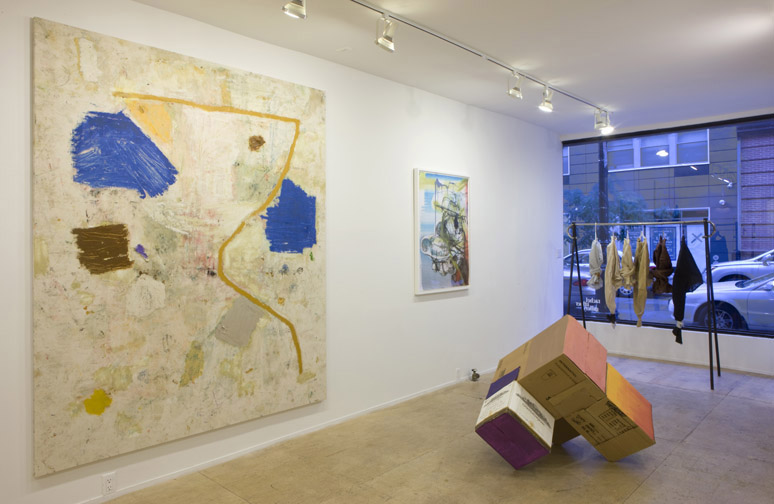
Using your memory is the only prerequisite for engaging with the group show, “You Were There,” at Rachel Uffner’s LES gallery this July and August. Curator Thomas Duncan selected two artworks each by artists Rita Ackermann, Justin Adian, Joe Bradley, Sarah Braman, Sara Greenberger Rafferty and Josh Smith: one from five years ago and a current piece for comparison. In keeping with the solipsistic effects of this summer’s heat wave, a reading of the evolution from the earlier work to the latter – a pin-ball like exercise when you take the show as a whole -- is meant to tease a parallel personal retrospection out of the viewer. “Where was I five years ago? How have I changed? What have I learned?”
Smith’s self-consciously painterly paintings are the only two pieces by the same artist shown side-by-side on the same wall, and so they serve as a key for reading the rest of the show: then versus now. His work also sets the overall stylistic tone: what is the least effort that can be made and yet still say something? Iterations and suggestions of the human form inhabit Rafferty’s, Ackermann’s and Bradley’s work; the other artists dwell more in an abstract realm. On the walls encircling Braman’s earnest set of knee-high, tumbling cube sculptures hang three pairs of paintings by Smith, Bradley, and Adian. Rafferty’s comedic and Ackerman’s popular fable work spar at the door and at the far end of the gallery. Scanning the show, you might be able to conclude, for example that Smith now voices his concerns more directly; or Braman has found more permanence and Bradley has learned to trust the human touch.
Five years is a meaningful span, Duncan told me, because it is long enough to remember and yet not too long to forget. The past is a construct formulated through the rolling lens of the present. Different distances at different speeds traveled within the same time span. We can know that for these particular artists the last five years have taken them from the early stages of their art careers to the next milestone (although Ackermann has had a bit of a head start.) The audience will have their own five years to dig into – wherever it may sit on their life’s number line -- and Duncan proposes that the fruits of the show lie in mirroring these impressions back on the show’s six youthful fictions.
The curator has successfully orchestrated the idea of multiple personal stories into the experience of reading the show. The under-built, barely held-together aesthetic heightens the fascination and reinforces the link to fleeting qualities associated with memory. Relinquishing to a purely formal reading reveals attractive cross-artist coincidences of color, form, and finish as the show’s visual underpinning. The pleasure of the making these surprising material connections has the feeling of a personal epiphany. This aspect of experiencing the show is more credible than any interpretation of a specific artist’s recent personal awakening, especially as it might relate to one of our own.
Any references to national or world events that have affected the artists’ or our own individual experiences over the last five years are underplayed here. They are perceptible, however, in the ways they have been integrated into the recent changes in our own lives and revealed in our own personal meditations on measuring how far we’ve come, successes and failures, beginnings and endings. This may explain the overall transient, purposeful lack-of-commitment attitude of the work. It matches the feeling of flux and instability of our times. In this regard, time and perhaps personal memory is evoked by “You Were There.”
The Rachel Uffner Gallery is a typical LES space -- for the time being, anyway. It is a small storefront with scuffed plywood floors and remnants of the old, decorative, red and white tile “welcome mat” still evident outside the front door. It opened in 2008 – midway through the show’s conceptual time frame. More polished – and distancing -- white cube galleries are getting increasingly easier to come by in her neighborhood. Maybe only within the artworld is this evolution dependable.
The already precious feeling of the space reinforces Duncan’s idea for the show. We can imagine a time in the near future, when the LES will be unrecognizable, Uffner will have moved to larger quarters, and the picture of an intimate, roughly finished interior filled with mid-summer afternoon sunlight will mark a lost moment. This palpable nostalgia for our own recent past is encouraged in “You Were There.” Beyond the artwork shown, Rachel Uffner’s gallery itself becomes fused with the show’s premise. Against a backdrop of change, what you can count on is the value of experiencing art.
Above installation image of the exhibition "You Were There," at Rachel Uffner Gallery with artwork by (from left to right) Joe Bradley, Rita Ackermann, Sarah Braman and Sara Greenberger Rafferty courtesy of Rachel Uffner Gallery.